
Methodology
How Scientific Monitoring Structures Corporate Innovation Strategy
PhD in Chemistry and Head of the Innovation Management Department at F.initiatives

On this page
By Audrey Cassen and Charlie Grosman, Telecommunications Engineer and Chief Technology and Innovation Officer at F.initiatives, co-creator of the NeoPhi platform
The uncertainty of today’s world makes value creation extremely difficult for organisations. Anticipation and adaptation capabilities are becoming a major challenge for any company wishing to maintain its competitiveness. It is in this context that scientific monitoring emerges as an essential lever.
Scientific monitoring plays a decisive role in anticipating technical and technological disruptions. It feeds strategic thinking and effectively guides research projects. Companies and organisations must stay informed of the latest trends and scientific advances to avoid falling behind the competition and to quickly seize emerging opportunities.
Definition and Challenges of Scientific Monitoring
Scientific monitoring consists of collecting, analysing and disseminating in a structured manner relevant scientific information for the organisation. This process enables the identification of emerging trends, monitoring of competitor activity, inspiration for internal research and support for strategic decision-making.
The main challenges of this approach are:
- Anticipating technological developments in the market
- Detecting opportunities and threats in your field of activity
- Optimising R&D investments through effective resource allocation
- Strengthening collaborative innovation with academic and industrial partners
The Role of Scientific Monitoring in Innovation Strategy
Scientific monitoring occupies a central place in the development and success of a company’s innovation strategy.
A Factual Basis for Decision-Making
The innovation strategist uses scientific monitoring as a factual and objective basis for building strategy. It feeds reflection on the company’s R&D directions and informs strategic decision-making. Faced with uncertainty, the wise strategist relies on monitoring to build strategic scenarios, avoiding the pitfalls of a rigid roadmap.
An Accelerator for Developing Innovative Solutions
Scientific monitoring constitutes a clear accelerator for the development of innovative solutions. In support of R&D project planning, it avoids reinventing methods already documented and enables reliance on up-to-date knowledge. It thus facilitates optimal resource allocation by directing investments towards the most relevant subjects.
Enhanced Risk Management
Structured monitoring also contributes to risk and uncertainty management. It offers the possibility of detecting very early the threats likely to impact the sustainability of existing activities or business models. Scientific monitoring strengthens the organisation’s capacity to collaborate effectively with academic and industrial partners by promoting information sharing and the emergence of synergies.
Knowledge Capitalisation
Regarding knowledge and skills management, scientific monitoring, when well structured, contributes to knowledge capitalisation within the company. It makes the organisation more robust against the loss of key employees.
Did you know?
Analysing the company’s environment and project context, particularly on technical and technological aspects, is an integral part of best practices in R&D and innovation management. The international standard ISO 56001 (Innovation Management System) clearly states that the company must carefully study internal and external issues that impact its ability to innovate.
Importance of Scientific Monitoring for R&D Project Success
Scientific monitoring is one of the most decisive factors for R&D project success, as it acts before, during and after project development.
Effectively Guiding Work
Monitoring enables work to be guided effectively by identifying, upstream, the uncertainties specific to the scientific domain concerned as well as the technological barriers likely to slow research progress. This anticipation facilitates the adaptation of research strategies throughout the project.
Accelerating Problem Resolution
Through analysis of the scientific and technical state of the art, teams benefit from a clear vision of potential obstacles and propose creative ways to address them. R&D activity execution is thus optimised while facilitating the development of new solutions.
Avoiding Duplication of Efforts
At project level, structured scientific monitoring avoids duplicating efforts in developing techniques or methods that already exist. By staying informed of recent advances and proven solutions, the project manager optimises the use of human, financial and infrastructure resources.
Literature Review: A Structuring Step for Project Framing
More than a simple documentary exercise, the literature review structures initial thinking, informs methodological choices and ensures the scientific relevance of the approach.
Literature Review Methods
A rigorous literature review relies on several methodological steps:
- Documentary research: selection of relevant databases, use of appropriate keywords and application of clear inclusion and exclusion criteria.
- Critical analysis of sources: evaluation of the reliability of scientific journals (via conference rankings), novelty and relevance of publications.
- Thematic synthesis: organisation of results by major axes, facilitating understanding of trends and gaps in the field.
Identification of Technological Barriers
One of the major purposes of the literature review is to highlight scientific uncertainties: areas of incomplete knowledge, unsettled debates or contradictory results. It also enables identification of technical barriers, i.e. methodological obstacles that slow progress in the field.
From Review to Experimental Approach
In-depth literature analysis directly guides the definition of experimental strategy: it enables the formulation of robust hypotheses, targeting of variables to explore and anticipation of potential difficulties.
Structuring into Work Packages
Review results serve as the foundation for structuring into work packages of the project. Each package can be designed to overcome an identified barrier, explore an uncertainty or validate an innovative method.
Scientific Monitoring and Securing Public Funding
Public support schemes for research and innovation, whether project grants or R&D tax credits, require particularly rigorous justification and documentation.
Documentary Requirements
The admissibility of applications depends on their ability to demonstrate that the work undertaken aims either at acquiring new scientific knowledge or designing novel technologies. To meet these requirements, it is essential to establish a documented state of the art based on a comprehensive review of scientific literature.
The Case of Research Tax Credits
In the context of the Research Tax Credit (CIR) in France or funding awarded by the BMBF in Germany, submitted applications undergo in-depth review by scientists. A rigorous state-of-the-art analysis, referenced with scientific articles, patents and theses, is therefore essential: otherwise, the funding request may be rejected.
Artificial Intelligence and Scientific Monitoring
In recent years, artificial intelligence has been transforming scientific monitoring activity, particularly through advances in natural language processing (NLP) and knowledge extraction.
Automation and Large-Scale Analysis
These technologies enable automatic analysis of vast corpora of multilingual documents, identification of emerging trends and detection of weak signals that are difficult to spot through conventional human analysis.
The Contribution of Large Language Models (LLM)
The rise of large language models (GPT, Mistral, Claude, DeepSeek, Qwen) offers new capabilities:
- Automated synthesis of complex information
- Generation of personalised summaries
- Rapid extraction of relevant data
These tools act as a research accelerator, making processes faster and more comprehensive.
Limitations and Precautions
However, numerous pitfalls exist, including the unfortunate tendency of LLMs to hallucinate fictitious sources, which is particularly problematic in the context of rigorous scientific literature review.
NeoPhi: A Reliable AI-Based Solution for Scientific Monitoring
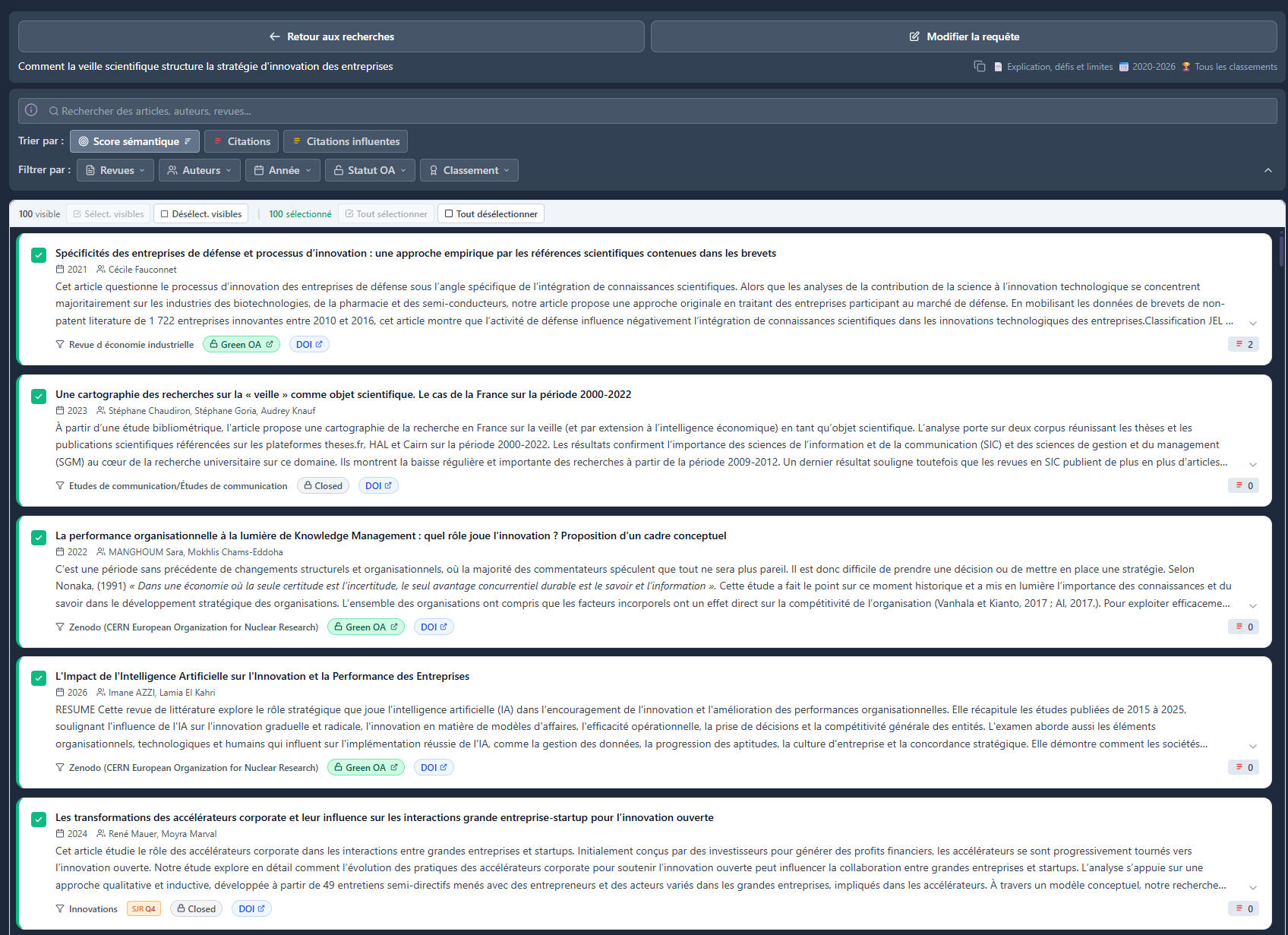
NeoPhi stands out as a scientific monitoring accelerator thanks to its artificial intelligence models that automate the collection, sorting and analysis of scientific information. The platform saves time and delivers more relevant results by automatically filtering reliable and recent content.
Comprehensive Scientific Exploration
NeoPhi leverages a wide variety of documentary sources, including OpenAlex, to offer complete scientific exploration:
- 467 million abstracts analysed, covering numerous domains
- 89 million publications selected as “Gold” for their quality
- 9 million distinct topics enabling targeted analyses
Advanced Ranking and Filtering
NeoPhi offers advanced tools for ranking and filtering scientific journals. The addition of conference and journal rankings according to CORE and Scimago standards enables rapid identification of the most reputable sources.
Mapping Scientific Relationships
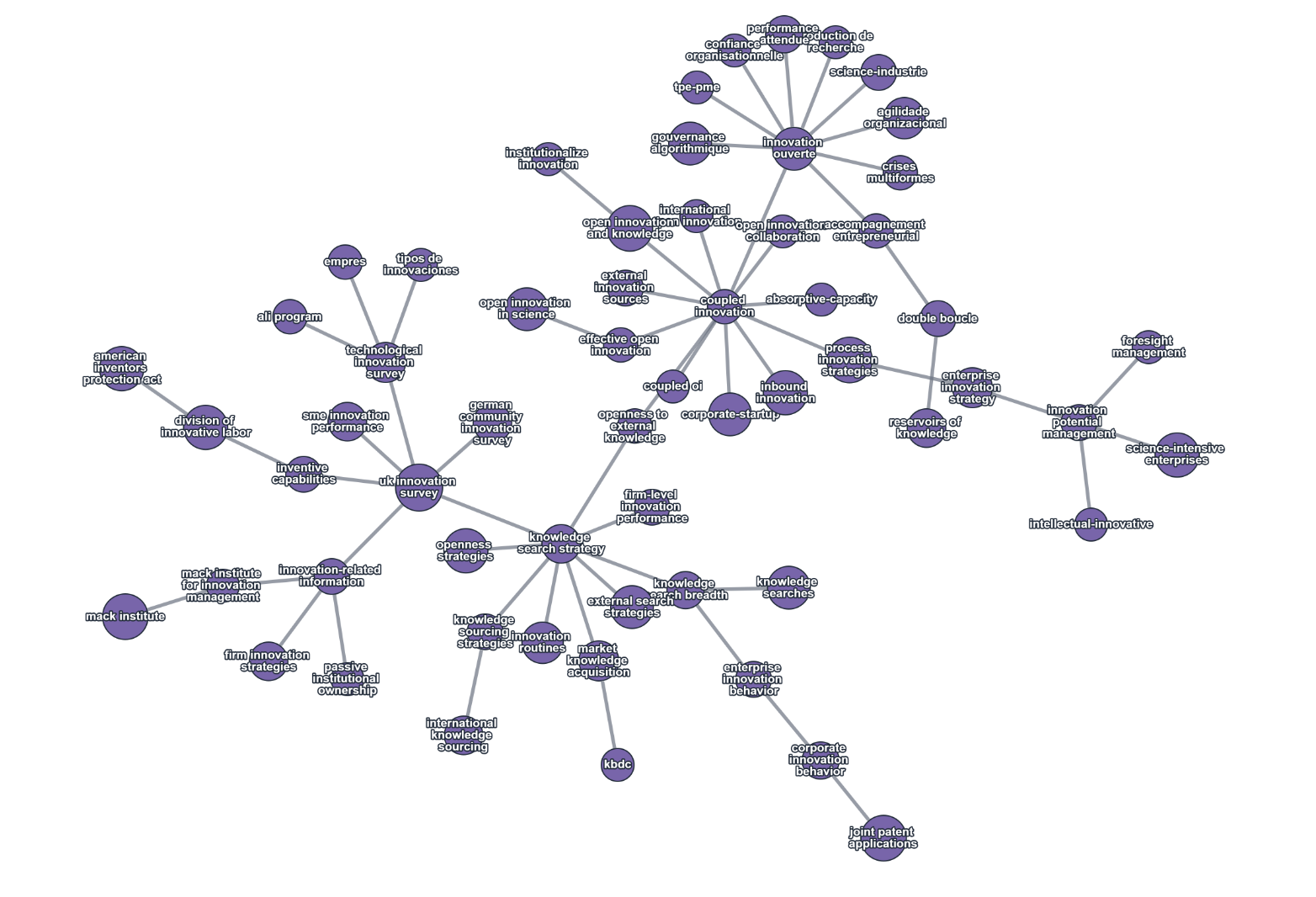
NeoPhi distinguishes itself through its ability to map a complex network of relationships between scientific entities several billion relationships between authors, institutions, concepts and publications are identified. The platform builds detailed knowledge graphs based on 2.4 billion relationships between 45 million scientific and technological concepts.
Referenced and Reliable Syntheses
NeoPhi generates syntheses exclusively based on selected sources. Each scientific statement is rigorously accompanied by citation of its original source, guaranteeing traceability and reliability of information.
It offers several synthesis formats:
- Explanation, challenges and limitations: popularisation for non-expert audiences
- Research axes: identification of emerging axes from the literature
- Explicit and related articles: priority identification of articles addressing the subject
FAQ: Scientific Monitoring and R&D
What is scientific monitoring in business?
The definition of scientific monitoring lies in a structured process of data collection, analysis and dissemination. It consists of actively monitoring scientific advances and technological world trends to feed corporate R&D departments.
Why is scientific monitoring crucial for R&D?
It enables anticipation of market disruptions and overcoming of each technical or technological barrier. By conducting a state of the art before launching a development, the project manager avoids duplicating existing methods and optimises the organisation’s resource allocation.
What are the main documentary sources to monitor?
Comprehensive monitoring relies on a wide variety of sources and publications: Scientific articles from international journals, patents filed in your field of activity and university theses and proceedings from reputable conferences
How is artificial intelligence transforming monitoring?
Artificial intelligence and large language models (LLM) act as a research accelerator. These tools automate the sorting of textual data, facilitate knowledge extraction and generate rapid syntheses. However, beware of fictitious source hallucinations typical of conventional AI.
What is the NeoPhi platform?
NeoPhi is an innovative AI-based software solution that secures and automates monitoring steps. By analysing over 467 million abstracts from databases like OpenAlex, the tool enables exploration of millions of topics and generation of knowledge graphs without risk of error.
Conclusion
Scientific monitoring appears as an essential lever for any organisation wishing to strengthen its innovation capacity and maintain its competitiveness. Thanks to powerful tools like NeoPhi, it is now possible to access massive data, map complex relationships within scientific research and precisely qualify the value of publications.
This structured approach promotes the identification of emerging trends, enrichment of strategic thinking and production of reliable analyses. Adopting advanced scientific monitoring means ensuring anticipation of major developments and staying at the forefront of your field.