Our story

NeoPhi is the result of more than seven years of scientific research and experimental development within F.initiatives.
Born from a passionate team founded as early as 2019, made up mainly of PhDs in computer science specialising in data mining, machine learning, and natural language processing.
It was born from the desire to push the boundaries of scientific knowledge exploration.
Drawing on F.initiatives’ many years of experience supporting organisations with their R&D, the team identified a growing need to improve and accelerate literature-review and state-of-the-art processes within companies’ scientific and technological departments.

This observation first led, in 2021, to an internal prototype named NASA (Navigation in Academic and Scientific Articles), which generated all the scientific concepts associated with a search from more than 200 million scientific articles, giving direct access to the article references specific to each concept.
In parallel, experimental work on the GPT-2 large language model laid the first foundations of generative features, well before the ChatGPT wave in late 2023.
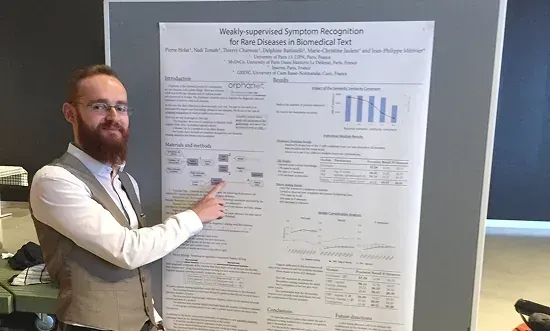
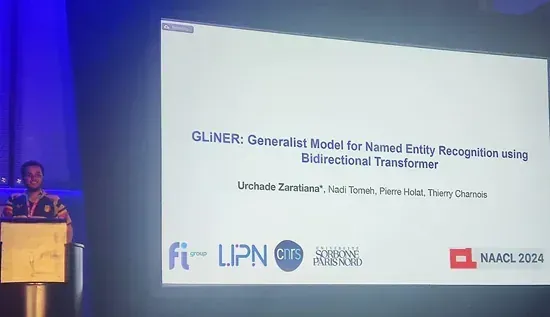
Subsequently, work on the GLiNER model (Generalist Model for Named Entity Recognition) — developed jointly with the Laboratoire d’Informatique de Paris Nord (LIPN), published and presented at the international NAACL 2024 conference and released as open source to the whole community — improved the extraction of relevant concepts and made a high-precision taxonomy possible.
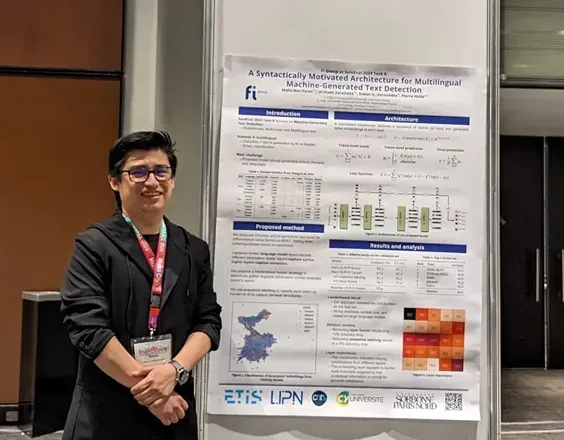
In 2024, the proliferation of AI-generated text — raising concerns about misinformation, academic fraud, and the potential erosion of trust in digital content — prompted the F.initiatives Research Lab to enter the international SemEval competition. It was the opportunity to build a multilingual AI-generated-text detection model, which placed 2nd (out of 338 participants).
All this work ultimately led to several prototypes (“Chat with Documents”, “Chat with Papers”, internal APIs, etc.) combining information extraction, article recommendation, concept-taxonomy exploration, text generation, and more — used by consultants and scientific analysts in their work with clients’ research teams to deepen their understanding of the existing literature.

The tools quickly proved their power, and it was decided that this innovation should not remain limited to F.initiatives’ staff but be placed directly in the hands of researchers and innovators worldwide — and so the NeoPhi platform was born.