
Research & Development
AI Finds the Target Faster Than You, but It Doesn’t Search Like You
Research Scientist at F-Initiatives, AIOps Architect at NeoPhi, PhD in Computer Science
On this page
Mohamed Amine Kerkouri is a Research Scientist at F-Initiatives and AIOps Architect at NeoPhi, where he designs and operationalises AI agents for scientific literature exploration, with a focus on building reliable workflows for retrieving, analysing and synthesising scientific knowledge.
He holds a PhD in Computer Science from the Université d’Orléans, where he developed deep learning models of human visual attention in paintings and created AVAtt, a gaze dataset for art. His research spans eye tracking, scanpath analysis and multimodal AI. In particular, his work on how AI models process and combine visual and textual information is closely connected to NeoPhi’s ambitions, as scientific publications increasingly need to be understood beyond text alone, including figures, diagrams and other visual scientific content.
His recent work on scanpath comparison methods was presented at ETRA 2026, and the paper featured in this post received the Outstanding Paper Award at the ECCV 2026 Human-Inspired Vision Workshop.
Introduction
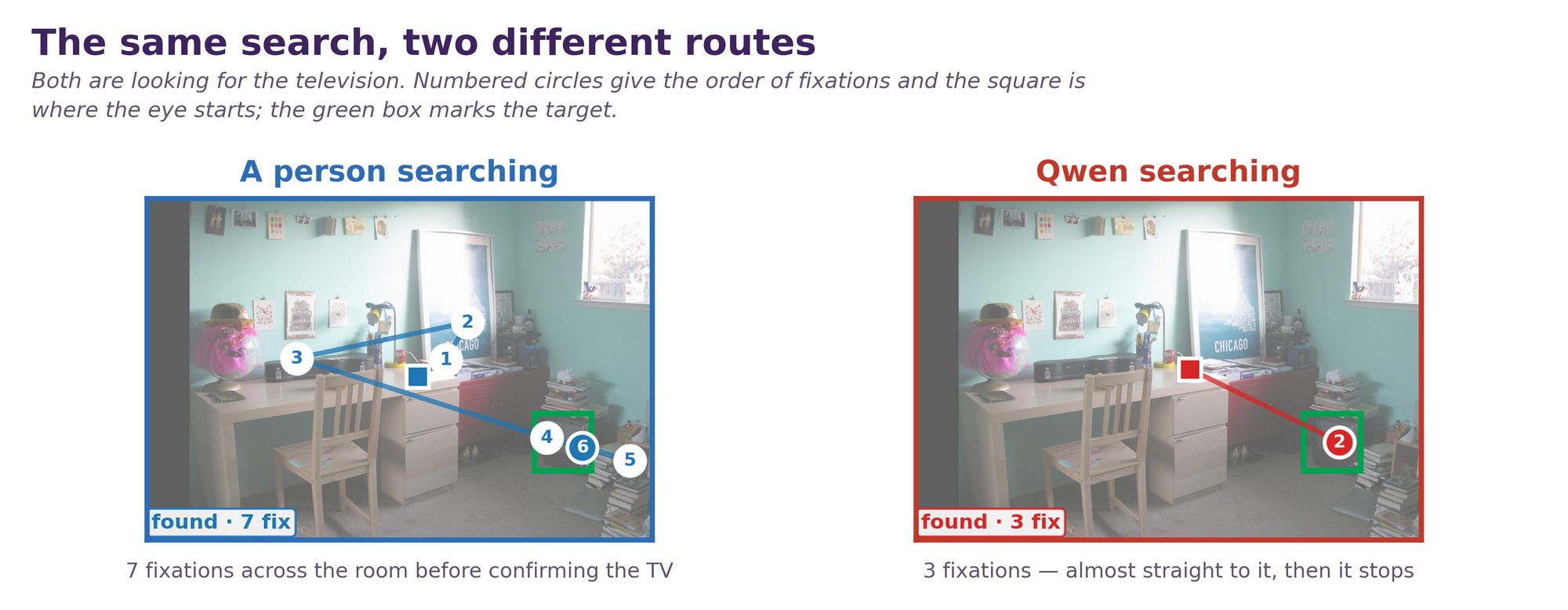
Fig. 1. The same search, two different routes. Left: a human looking for the TV makes 7 fixations across the room before confirming it. Right: the AI (Qwen, viewing through a simulated human eye) jumps almost straight to the target and stops after 3. Numbers show the order of fixations, and the green box marks the target.
Ask people to find an object in photos like this one, and their first eye movement lands on it about half the time. Give the same task to a multimodal AI model looking through a simulated human eye, and it lands on the target almost every time, 97% of the time for the best models.
That sounds like a win for human-like AI vision. It isn’t. In our new paper, we found that these models reach the right answer by a completely different route. They match human outcomes, but their search process looks nothing like ours. That gap matters, because the scores we usually use to judge whether AI “sees like us” can’t detect it.
Why this matters now
Researchers increasingly use multimodal large language models, the AI systems that can read both images and text, as stand-ins for human observers. A common shortcut is to check whether a model gets the same answers as people, or whether it attends to the same parts of an image. If it does, the model is often described as seeing the way humans do.
We wanted to test that shortcut on one of the most basic things human vision does: searching for something.
Giving an AI a human eye
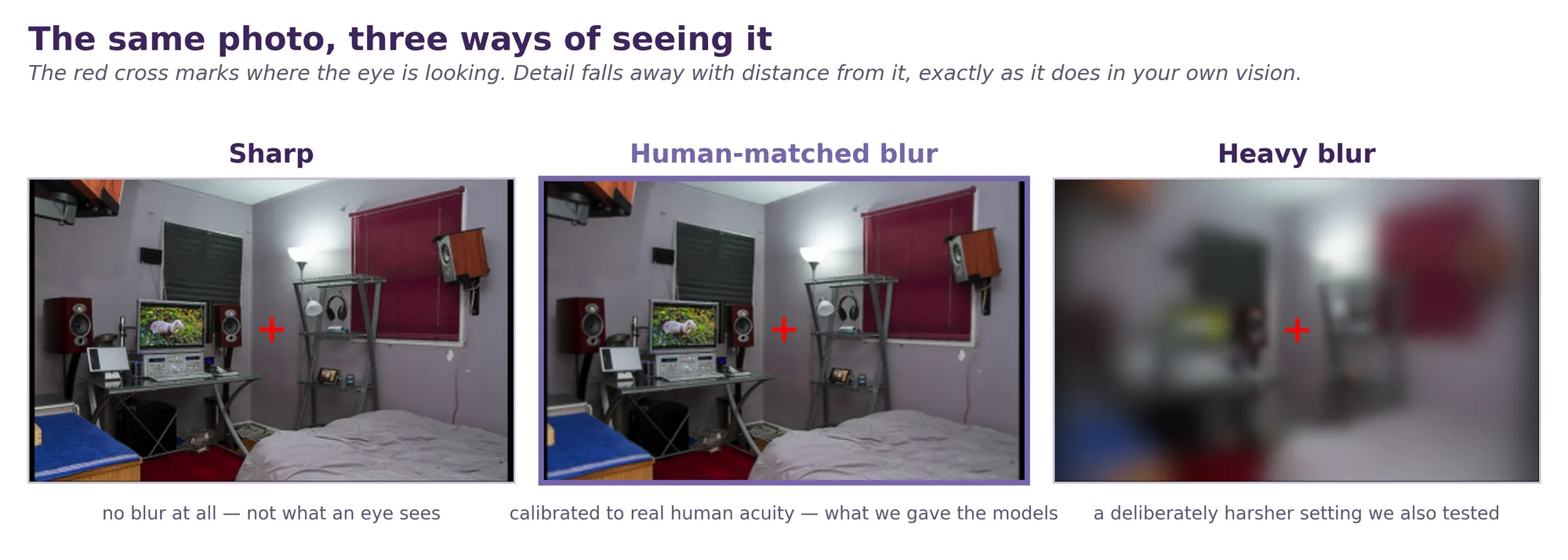
Fig. 2. Three versions of the same bedroom photo. The first is sharp, the second is almost identical with slight blurring toward the edges, and the third is heavily blurred except near a small red cross in the centre.
Human eyes only see sharply in a tiny spot at the centre of gaze. Everything else is a blur. To find something, you have to move your eyes, check, and move again. The trail of those stops is called a scanpath.
We recreated this for three AI models from different families: Qwen, GLM and Gemma. Each model controlled a single virtual eye. At every step it saw the photo sharp where it was looking and blurred elsewhere, using a blur calibrated to real human vision. It then had to choose one of three moves: look somewhere else, say “found it,” or say “it’s not here.”
We ran more than 38,000 of these searches on photos from COCO-Search18, a dataset in which ten real people searched each scene while their eye movements were recorded. That gave us a direct human comparison for every trial.
Same answers, different search
On results, the models were as good as people or better. They correctly judged whether the target was present, found it at least as often as humans did, and needed no more eye movements to do it.
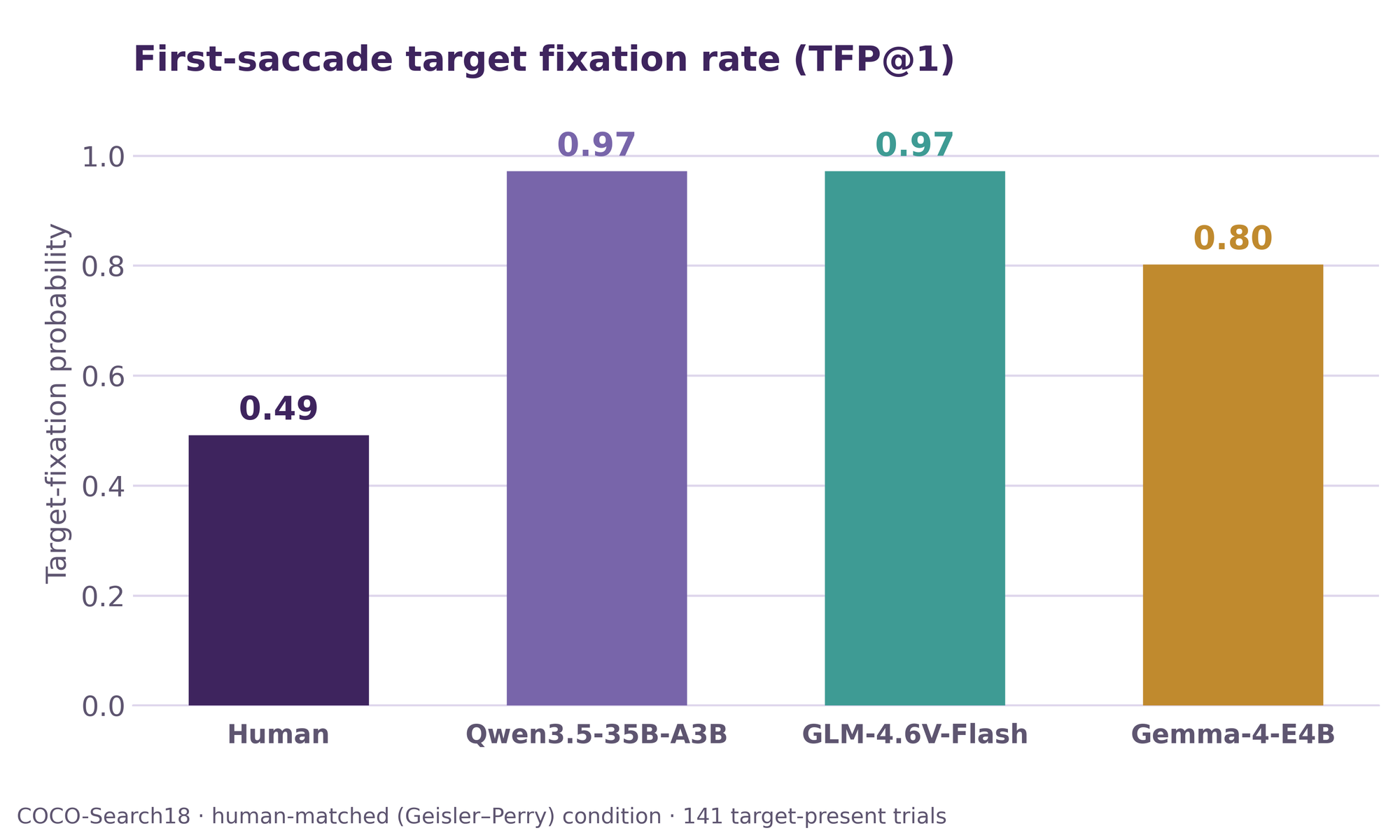
Fig. 3. How often the first eye movement lands on the target. Humans manage it about half the time (49%). All three AI models do far better: 97% for Qwen and GLM, and 80% for Gemma. Results are averaged over 141 scenes where the target was present.
On the process level, they were clearly not human, and all three models differed from humans in the same three ways:
They make one big jump instead of exploring. People spread their gaze around a scene, while the models leap straight to the target and stop.
They cover very little ground. Their gaze stays concentrated in a few spots instead of sampling the scene.
They repeat themselves almost exactly. When the same model searches the same photo several times, it takes nearly the same path each time. Two different people searching the same photo agree far less than a model agrees with itself. This held even when we deliberately made the models more random.
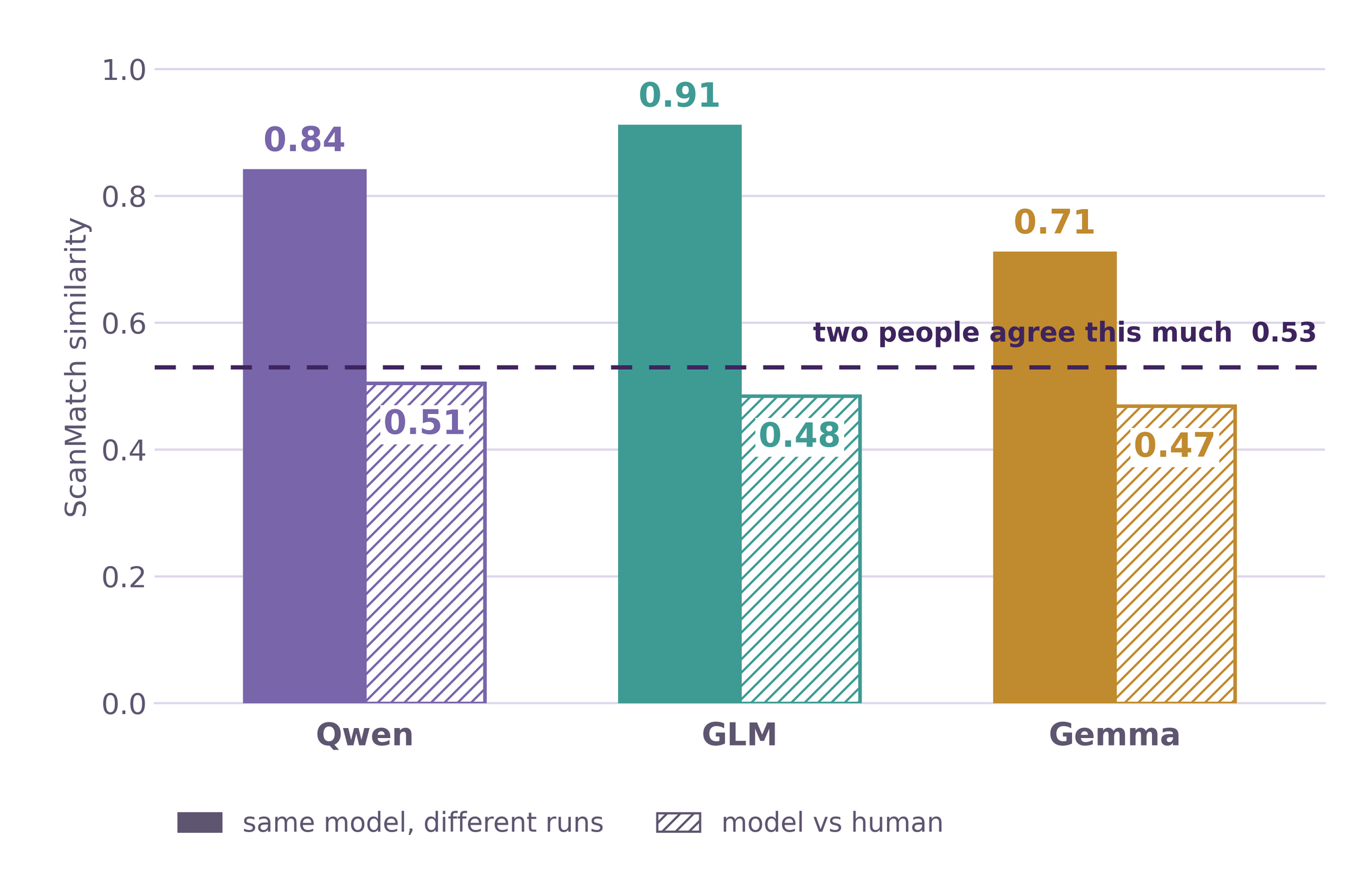
Fig. 4. Each model repeats itself more than people agree with each other.
Blurrier vision doesn’t fix it
A natural objection is that our simulated eye wasn’t blurry enough, so the models could simply see too much. We tested this directly.
First, the human-calibrated blur made essentially no difference to the models, which behaved the same with it as with a perfectly sharp image.
Second, we made the blur progressively harsher. The models never started searching like people. Their first-glance accuracy and their overall success dropped together, so by the time the first glance was only as good as a human’s, the models were missing targets people routinely find. When their gaze patterns did start to resemble ours, it was because they were failing: circling back to spots they couldn’t make out, then giving up and saying “not here.”
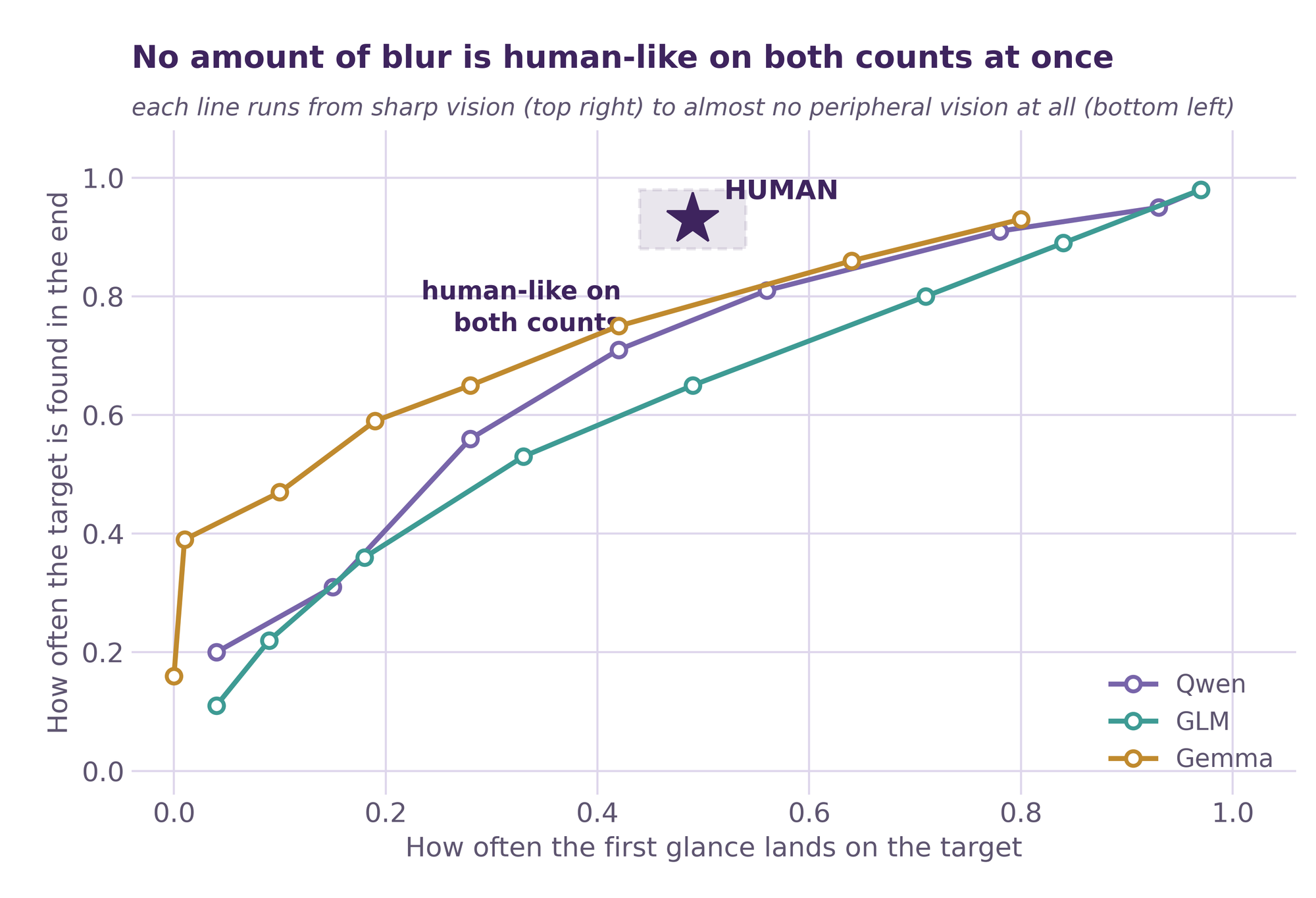
Fig. 5. No amount of blur makes the models search like humans.
Interestingly, the models do look in roughly the same places people do. Their maps of where they looked overlap reasonably well with human maps. What they don’t reproduce is how looking unfolds over time. Our best explanation is that these models take in a whole image at once, while human vision has to proceed one glance after another. We haven’t changed the models’ architecture to test this causally, so that step remains future work.
The takeaway
Getting the right answer isn’t the same as seeing the way humans do. If you measure only final answers, or only which parts of an image a model attends to, AI models can look convincingly human while the underlying process is completely different.
That gives us two practical lessons:
- AI models make good stand-ins for questions about outcomes. They can tell you what people are likely to notice, roughly where they’ll look, and whether they’ll judge a target present.
- They make poor stand-ins for questions about process. They can’t tell you how people move their eyes, how long they search, or when they decide to stop.
There’s an upside too. A system that gets human-level results without searching one glance at a time is a useful yardstick. Comparing it with human search helps isolate which parts of our behavior exist specifically because we have to look one spot at a time.
If you work on AI evaluation or human vision, the lesson is simple: when you ask whether a model “sees like us,” make sure you’re measuring how it looks, not just what it concludes.
Frequently Asked Questions
What is the main difference between AI vision and human vision?
AI models can achieve similar or better results than humans when searching for visual targets, but their search process is different. Humans move their eyes through a scene using multiple fixations, while the AI models tested often jump directly toward the target.
Can AI models search images like humans?
Not necessarily. The research shows multimodal AI models can produce human-like outcomes without reproducing human visual search processes. Their gaze patterns, exploration, and repetition differ substantially.
How accurate are AI models at finding visual targets?
In the study, the first eye movement landed on the target in 97% of target-present scenes for Qwen and GLM and 80% for Gemma, compared with 49% for humans. These results describe the tested models and scenes, not all AI visual search tasks.
What is visual search in AI?
Visual search is the task of locating a specified object or target within an image. In this study, AI models performed the task through a simulated human eye.
What is a scanpath?
A scanpath is the sequence of gaze fixations made while looking through a scene.
What is multimodal AI?
Multimodal AI processes more than one kind of input, such as images and text. The study tested models from the Qwen, GLM and Gemma families.
Does making AI vision blurrier make AI search more like humans?
No. Increasing the simulated blur reduced the models’ search performance but did not reproduce the human search process.
Why does it matter if AI gets the right answer?
Matching a final answer does not establish that the underlying process is the same. The models could locate targets successfully while following different gaze patterns from people.
Can AI models be used as stand-ins for human observers?
The findings support using these models for some questions about outcomes, such as whether a target will be noticed, but caution against using them to infer the sequence and timing of human eye movements.
What AI models were tested?
The study tested three model families: Qwen, GLM and Gemma.
How many visual searches were analyzed?
The researchers ran more than 38,000 AI searches on images from COCO-Search18 and compared them with recorded human eye movements.
What does this research tell us about human-like AI?
Similar outcomes do not necessarily mean similar processes. Evaluating whether AI vision resembles human vision requires measuring how a model searches, not only what it concludes.