
Environment
El Niño 2026-2027: How Does Global Warming Amplify Its Impacts?
Director of NeoPhi

On this page

El Niño 2026-2027: How Does Global Warming Amplify Its Impacts?
Article developed using NeoPhi, under the editorial supervision of Charlie Grosman, Director of NeoPhi. This analysis draws on 21 scientific publications from 2025 and 2026, identified and explored using NeoPhi.
“A supersized El Niño is colliding with a planet already superheated by manmade climate change.”
With this particularly evocative statement, António Guterres, Secretary-General of the United Nations, summed up one of the major climate concerns of the moment on 9 November 2026, at the opening of COP31 in Antalya, Türkiye. According to the World Meteorological Organization, the ongoing El Niño episode could become one of the strongest ever observed, while the oceans continue to accumulate record amounts of heat.
This raises a fundamental scientific question: what happens when natural climate variability meets a climate system already profoundly altered by human activities?
Against this backdrop, we used the NeoPhi platform to explore the latest published scientific knowledge on the El Niño-Southern Oscillation (ENSO), which also encompasses the cooling phase known as La Niña, and its interaction with anthropogenic global warming.
What Is ENSO and How Does It Influence the Climate?
The El Niño-Southern Oscillation (ENSO) is the dominant mode of year-to-year climate variability. It affects temperatures and precipitation far beyond the tropical Pacific [Estrada et al., 2025].
How does human-induced warming alter this phenomenon and its impacts?
To answer this question, recent research draws in particular on CMIP6¹ simulations. These studies seek to distinguish natural climate fluctuations from changes linked to human activities.
The challenge is therefore not simply to determine whether El Niño episodes are becoming more intense, but also to understand how global warming alters their underlying mechanisms and worldwide consequences.
¹ Coupled Model Intercomparison Project, Phase 6: a major international framework for comparing and coordinating simulations produced by global climate models.
Can Global Warming Intensify El Niño?
A More Intense ENSO, but a Non-linear Evolution
Over the twenty-first century, most models project more frequent ENSO episodes and greater variability in both the eastern and central Pacific [Coquereau et al., 2025].
Stronger ocean-atmosphere interactions could also make the phenomenon more predictable: heat transport by ocean currents and changes in the thermocline, which separates warm surface waters from colder deep waters, play an important role here [Lin et al., 2026].
However, this trend would not continue indefinitely. Beyond 2100, under extreme warming scenarios, some simulations show a reduction in ENSO amplitude and in the differences between El Niño and La Niña. Episodes would occur closer together, with a cycle of 2 to 3 years, and would be more concentrated in the central Pacific [Hayashi et al., 2026].
These changes depend in particular on the stratification of the upper ocean layers, which alters the mechanisms that sustain ENSO [Rong-Hua Zhang et al., 2026].
In a warmer eastern Pacific, atmospheric convection would also be triggered more readily, reducing differences in the response to El Niño and La Niña [Geng & Cai, 2025]
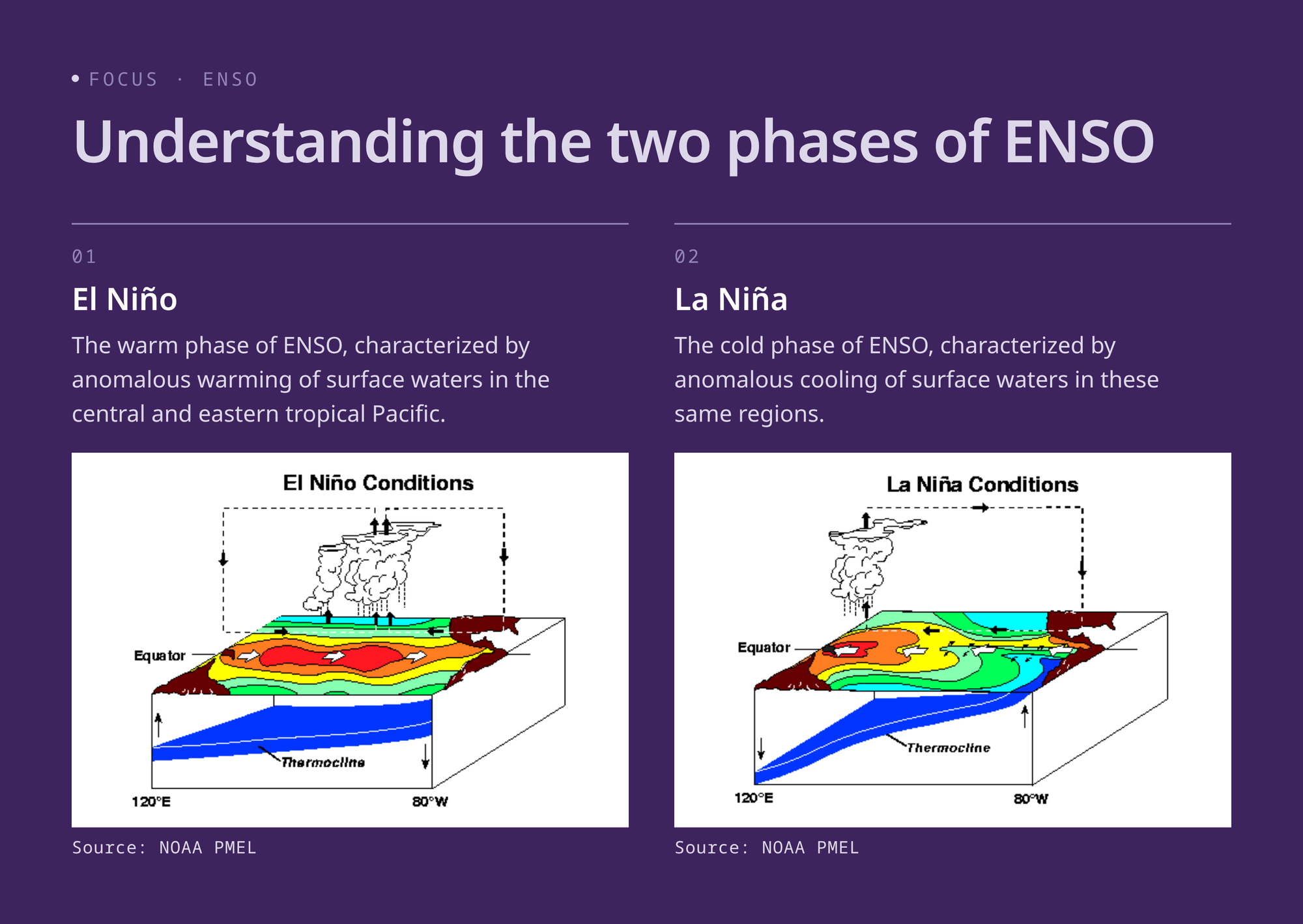
Schematic diagrams of El Niño (left) and La Niña (right) conditions in the tropical Pacific, between 120°E (Indonesia) and 80°W (the coast of South America). Colours indicate surface-water temperature, from red (warm) to blue (cold). Source: NOAA PMEL.
Stronger Climate Teleconnections Worldwide
These changes in the Pacific can affect other regions through teleconnections, that is, climate connections over long distances.
In a warmer climate, models project a greater influence of ENSO on sea surface temperatures worldwide, particularly through stronger atmospheric interactions and increased humidity [Hong et al., 2026].
Under a high-emissions scenario, more episodes would follow established teleconnection patterns, potentially improving certain ENSO-based forecasts [Liu et al., 2026].
Some simulations also suggest synchronisation with other climate modes, such as the North Atlantic Oscillation (NAO) and the Indian Ocean Dipole (IOD), which could amplify impacts on rainfall and water resources [Stuecker et al., 2025].
What Regional Risks Are Associated with El Niño?
Although ENSO mechanisms originate in the tropical Pacific, their consequences can be observed thousands of kilometres away, with markedly different effects across regions.
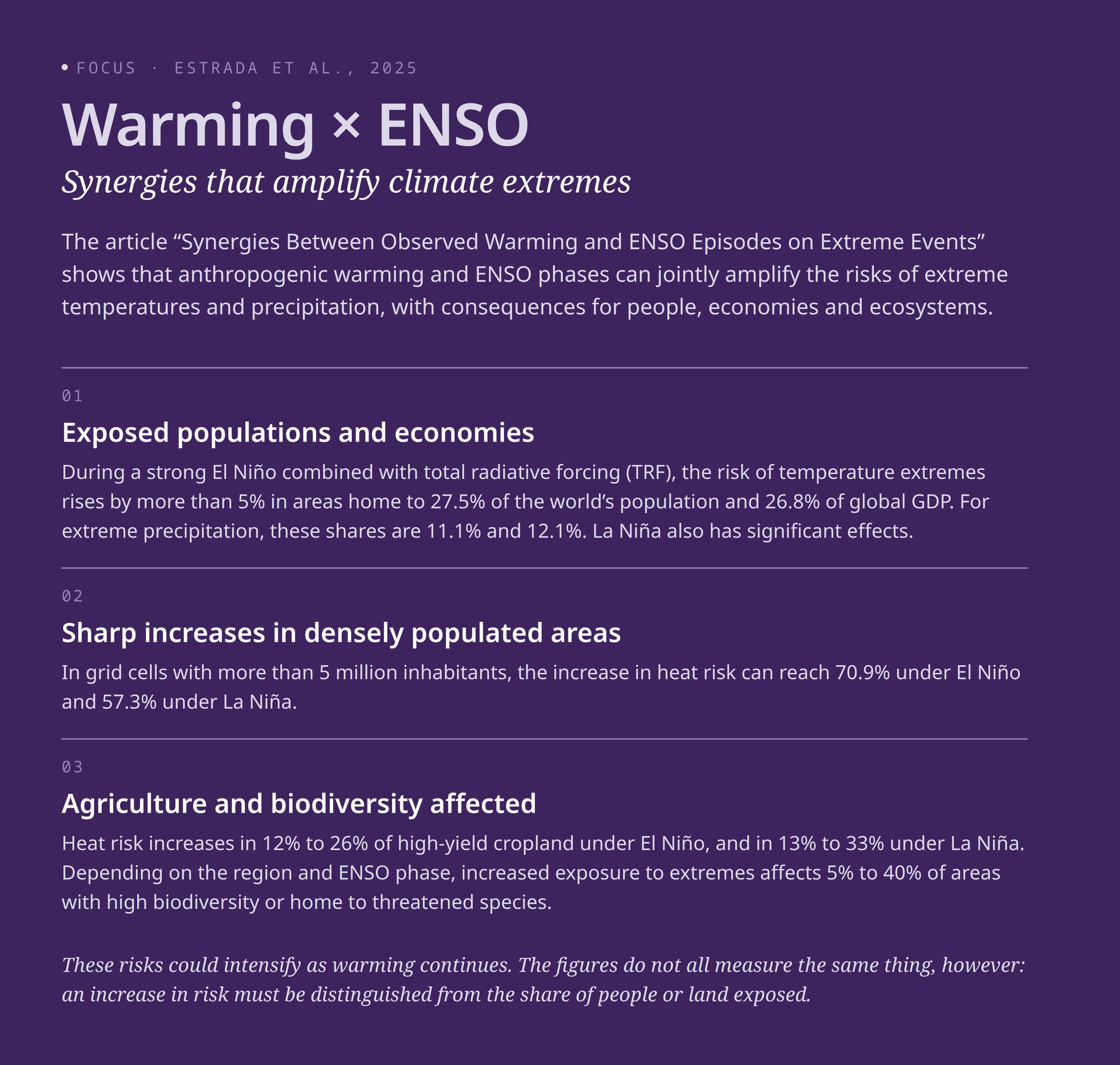
These long-distance effects have tangible consequences. Current warming amplifies ENSO’s effects on extreme temperatures and precipitation, increasing risks for populations, ecosystems and agriculture [Estrada et al., 2025] (see inset).
Projections nevertheless vary by region.
Potential Impacts in Southeast Asia and China
In Southeast Asia, ENSO’s effects on rainfall, evaporation, runoff and soil moisture could intensify during the twenty-first century [Le, 2025].
In China, stronger warming in the eastern Pacific could exacerbate summer rainfall deficits or excesses by changing the distribution of water vapour and convection [Wang et al., 2025].
More Extreme Rainfall and Droughts in the Americas
In the United States, more intense ENSO episodes and stronger teleconnections could increase variability in winter rainfall and associated extreme events [Hong et al., 2025].
Other studies project worsening droughts in southern Mexico, Central America and the Amazon, as well as changes in extreme rainfall along the western coast of the United States, depending on the spatial pattern of warming in the tropical Pacific [Heede et al., 2025].
Focus: Scientific Study on the Combined Effects of Warming and ENSO
Why Do Climate Projections Remain Uncertain?
Significant Uncertainties Remain
These projections do not, however, allow all local impacts to be predicted precisely.
Models still represent ocean-atmosphere interactions imperfectly: they may underestimate extreme El Niño episodes and fail to reproduce convection accurately in the western Pacific [Sanabria et al., 2025].
Natural climate fluctuations also remain a major source of uncertainty in projections of extreme precipitation [Sothearith et al., 2026].
Further difficulties arise in simulating the spatial pattern of ocean warming and its long-distance effects, as illustrated by discrepancies between CMIP6 simulations and recent observations [Danielli et al., 2025].
Finally, when a heatwave and flooding, or drought and intense heat, occur together, it remains difficult to distinguish the respective contributions of atmospheric circulation, ENSO and anthropogenic warming [Jianjun Wang et al., 2026].
How Can El Niño Forecasting Be Improved?
Better Forecasting for Better Adaptation
Reducing these uncertainties requires better representation of the underlying physical mechanisms.
Researchers are exploring high-resolution models and machine-learning methods that incorporate causal relationships [Cui et al., 2026].
They also seek to improve the representation of deep convection and subsurface ocean mixing, which influence the diversity of ENSO episodes [Hu et al., 2026].
Large simulation ensembles can help distinguish human-induced changes from natural climate fluctuations [Dwyer et al., 2026].
The next challenge is to translate these advances into local adaptation strategies through collaboration among climatologists, hydrologists and risk-management specialists [Le, 2025].
Key Takeaways on El Niño and Global Warming
Anthropogenic warming does more than alter the average climate: it also transforms ENSO dynamics and their long-distance effects.
Simulations generally project intensification during the twenty-first century, but neither a continuous increase nor identical consequences everywhere. In the longer term, some trends could even reverse.
Greater ENSO predictability therefore does not mean that all its regional impacts become predictable.
The main uncertainties still concern ocean-atmosphere interactions, the spatial distribution of ocean warming and the contribution of natural fluctuations.
A better understanding of these mechanisms is essential for translating global projections into adaptation strategies tailored to individual regions.
How NeoPhi Contributed to This Scientific Exploration
This article draws on an exploration of the scientific literature conducted using NeoPhi to identify and contextualise recent studies on ENSO, global warming and their interactions.
The selected publications make it possible to compare different modelling approaches, examine regional projections and better understand the uncertainties that remain.
FAQ: El Niño 2026-2027 and Climate Change
What Is ENSO?
The El Niño-Southern Oscillation (ENSO) is a natural phenomenon of climate variability in the tropical Pacific. It includes a warm phase, El Niño, and a cool phase, La Niña. Its effects on atmospheric circulation influence temperatures and precipitation across different regions of the world.
Does Climate Change Make El Niño More Intense?
Climate simulations generally project an increase in the frequency and variability of ENSO episodes during the twenty-first century. However, this evolution is non-linear and depends on warming scenarios. Research also suggests that climate change could amplify certain regional impacts of El Niño.
What Are the Effects of El Niño in Europe and Worldwide?
El Niño can alter temperature and precipitation patterns through climate teleconnections. Research identifies increased risks of drought, extreme rainfall and hydrological disruption in several regions of Asia and the Americas. In Europe, its effects are more indirect and remain difficult to predict at the local scale.
Can Future El Niño Episodes Be Forecast?
Climate models can anticipate some ENSO developments, but uncertainties remain, particularly regarding ocean-atmosphere interactions. Recent research explores high-resolution simulations and machine-learning methods to improve forecasts and better assess regional consequences.
Bibliography
Coquereau, A., Sévellec, F., Huck, T., & Fedorov, A. V. (2025). Increase in ENSO Frequency and Intensity Under 20th and 21st Century Warming: Insights From CMIP6 Large Ensembles. Geophysical Research Letters, 52(22).
Cui, Y., Mu, B., Yuan, S., & Qin, B. (2026). ENSO-CausalNet: Integrating Causal Inference Into Deep Learning for Robust ENSO Prediction. Geophysical Research Letters, 53(1).
Danielli, V., Lengaigne, M., Kwatra, S., Gopika, S., & Vialard, J. (2025). Drivers of CMIP Tropical Pacific Warming Pattern Diversity. Earth’s Future, 13(8).
Deser, C., Yeager, S., Phillips, A. S., Rosenbloom, N., & Zhao, X. (2025). Northern Hemisphere Wintertime Teleconnections from the 2023–24 El Niño Offset by Background SST Trends. Journal of Climate, 39(1), 363–383.
Dwyer, A., Hurrell, J. W., & Barnes, E. A. (2026). The role of internal variability and external forcing on the emergence of hot and dry compound extremes in the CESM2 large ensemble. Frontiers in Climate, 8.
Estrada, F., Perrón, P., & Yamamoto, Y. (2025). Synergies Between Observed Warming and ENSO Episodes on Extreme Events. Annals of the New York Academy of Sciences, 1554(1), 95–109.
Geng, T., & Cai, W. (2025). Enhanced Eastern Pacific Warming Weakens ENSO Asymmetry Post-2100 Under Persistent Greenhouse Warming. Geophysical Research Letters, 52(13).
Hayashi, M., Yokohata, T., Shiogama, H., Ogura, T., Hajima, T., Jin, F.-F., Zhao, S., & Stuecker, M. F. (2026). Unraveling non-monotonic responses of the El Niño-Southern Oscillation to post-2100 global warming. npj Climate and Atmospheric Science, 9(1).
Heede, U. K., Lenssen, N., Karnauskas, K. B., & Deser, C. (2025). Tropical Pacific Warming Patterns Influence Future Hydroclimate Shifts and Extremes in the Americas. Earth’s Future, 13(9).
Hong, J., Kim, D., Lopez, H., Lee, S., Mercer, A. E., & Johnson, N. C. (2025). Projected increase in ENSO-induced US winter extreme hydroclimate events in SPEAR large ensemble simulation. npj Climate and Atmospheric Science, 8(1).
Hong, S. S., Kim, G.-I., Shin, Y., Iwakiri, T., & Kug, J.-S. (2026). Stronger ENSO-induced global SST variability in a warming climate. Nature Communications, 17(1).
Hu, Q., Liu, C., Jia, Y., Wang, F. T., Gao, C., & Zhang, R.-H. (2026). Subsurface Mixing Promotes Central Pacific-like ENSO in an Intermediate Coupled Model. Journal of Climate, 39(10), 2483–2504.
Wang, J., Gu, X., Gu, T., Li, L., Jiang, Z., Xiao, W., & Wang, L. (2026). Attribution of the 2022 Asian Spatially Compound Heatwave-Flooding Event to Atmospheric Circulation, La Niña and Anthropogenic Warming. Journal of Geophysical Research: Atmospheres, 131(4).
Le, T. (2025). Future intensification of ENSO impacts on the Southeast Asian hydroclimate. Hydrological Sciences Journal, 71(3), 544–551.
Lin, Z., Jin, Y., He, C., Zhang, S., McPhaden, M. J., & Lin, X. (2026). Deep learning reveals enhanced ENSO predictability under historical anthropogenic forcing. Science Advances, 12(24), eaec9518.
Liu, S., Dong, L., Song, F., McPhaden, M. J., & Wu, L. (2026). ENSO’s Strengthened Control over Global Climate Anomalies in a Warmer World. Journal of Climate, 39(10), 2593–2607.
Zhang, R.-H., Chen, M., Gao, C., Zhou, L., Zhi, H., Liu, S., Tao, L., Wu, M., Gao, J., & Wang, H. (2026). Upper-ocean stratification changes control ENSO amplitude shift under sustained global warming. Nature Communications, 17(1).
Sanabria, J., Neukom, R., Llacza, A., Salzmann, N., & Calanca, P. (2025). Representation of extreme El Niño events and associated atmospheric moisture flux divergence in the central-eastern tropical Pacific in a CMIP6 model ensemble. Weather and Climate Extremes, 47, 100746.
Sothearith, M., Park, D., & Ahn, K.-H. (2026). Dynamic internal variability dominates uncertainty in modeling future extreme precipitation. npj Climate and Atmospheric Science, 9(1).
Stuecker, M. F., Zhao, S., Timmermann, A., Ghosh, R., Semmler, T., Lee, S., Moon, J.-Y., Jin, F., & Jung, T. (2025). Global climate mode resonance due to rapidly intensifying El Niño-Southern Oscillation. Nature Communications, 16(1), 9013.
Wang, C., Geng, X., & Li, W. (2025). Modulation of the Sea Surface Temperature Warming Patterns on the Precipitation Response in Central-Eastern China to ENSO during the Developing Summer. Journal of Climate, 38(14), 3579–3592.